
Truly clean facilities require more than just a simple wipe down. Electrostatic Cleaning uses a small electrical charge to liquid disinfectants as they move through a sprayer nozzle. This simple modification changes the way the liquid behaves, enabling it to coat hard-to-reach surfaces completely.
This guide will explain the physics behind this process, and help you see why it’s what modern facility managers depend on to save money while providing superior cleaning and sanitation.
The Droplet Charging Process
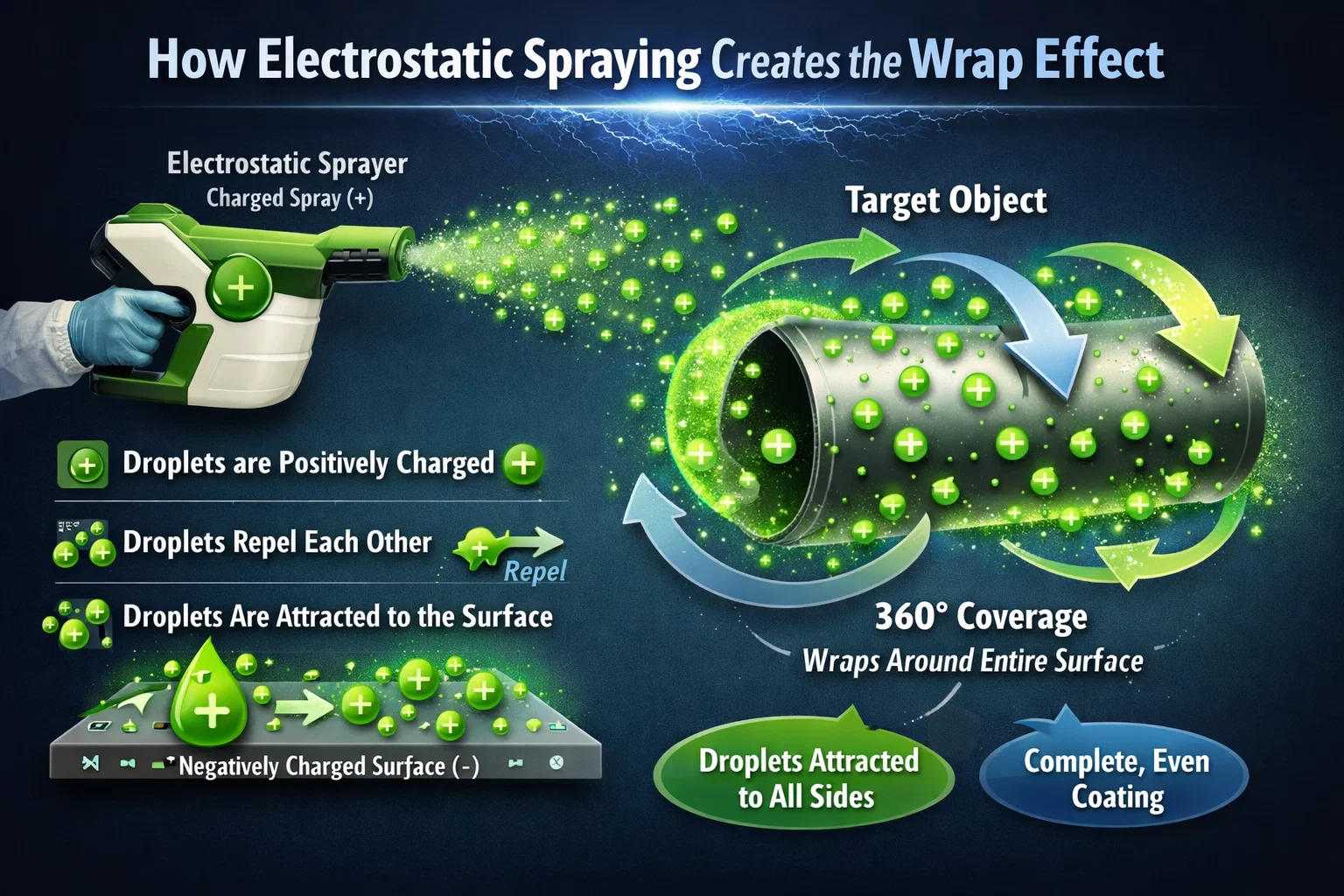
The science of this sanitation method hinges on a simple principle of physics known as Coulomb’s law. The liquid, upon exiting the sprayer, develops a positive charge. As many surfaces in a room carry a neutral or negative charge, they attract the spray like magnets.
In the air, the charged droplets repel one another. This strong repulsion results in a fine, homogeneous mist instead of large clumps or drops of liquid. Then droplets actively search for the closest surface. They don’t simply alight on the top of an object; the magnetic force drags the droplets along the sides and beneath the chairs to form a 360-degree coat, known as the wrap effect.
Traditional Trigger Spraying vs. Electrostatic Spraying
Shifting from regular spray bottles to sophisticated electrostatic systems alters the whole workflow for a cleaning crew. Here are some comparisons based on industry field studies about the two methods:
| Feature | Traditional Trigger Spraying | Electrostatic Spraying |
| Curved Surface Coverage | Less than 10% coverage | Greater than 70% coverage |
| Chemical Waste | High (liquid pooling and runoff) | Low (even, thin distribution) |
| Labor Hours | Highly labor-intensive | Reduced by up to 50% |
| Application Method | Manual spray and wipe | Touchless, wrap-around mist |
Visualizing Coverage with Advanced Technology
Facility management software is now incorporating visual tracking tools to enhance hygiene through accurate sanitation. Using ARK augmented reality, for instance, allows cleaning teams to see real-time coverage of high-touch surfaces. The adaptive technology follows the operator as they work by mapping the physical environment and tracking motion.
Through an AR interface, managers can view a digital overlay that specifies exactly which desks, door handles, and chairs have been treated. Now operators can rest assured they never miss a spot, and facility owners are left with irrefutable evidence of service.
Practical Benefits for Facility Managers
Both scalable designs and a transition to charged-mist systems have immediate benefits for industrial sources.
- Pathogen Reduction: The wrap effect ensures disinfectants make direct contact with the undersides of hospital beds, gym equipment, and desks in schools, where bacteria are most prevalent.
- Cost-Efficiency: With more uniform distribution without clumping of the chemical solution, facilities use much less per foot (cost).
- Labor Savings: Operators can complete a 1,000-square-foot space in minutes, allowing them to spend time on other important maintenance–maintenance that typically brings the building more revenue.
Why This Technology is Essential for Modern Sanitation
It’s clear that the demand for pristine public spaces is as strong as ever. Normal cleaning techniques leave hazardous gaps in coverage, relying solely on the worker’s physical thoroughness. Electrostatic technology eliminates human error from the process. The physics governing the wrap effect ensures disinfectants hit every curve and crevice. When combined with smart mapping tools, it offers a verifiable, highly efficient sanitation process that protects public health and reduces operational costs.
FAQs
Is the electrical charge safe for operators?
Yes. The current applied to the droplets is incredibly low. While being applied, it does not endanger the operator or anyone else present in the room.
How long does the electrostatic charge last?
The charge lasts only long enough for the droplet to reach from the nozzle to the surface. When the liquid contacts the grounded object, it discharges instantly.
Can I use any chemical in an electrostatic sprayer?
No. That means you should use EPA-approved water-soluble disinfectants specifically intended for these systems. Oil-based chemicals or viscous gels will gunk up the nozzle and won’t hold a proper charge.
Does the mist damage electronics?
When used properly, the fine mist safely coats keyboards, phones, and monitors without causing moisture damage. Because the droplets are small, they cannot pool or penetrate internal circuitry.
Do I still need to wipe surfaces after spraying?
Electrostatic disinfectants are treated to dry in the air. You just spray it on the surface and let that chemical do its job for the dwell time to kill pathogens.
