
Project: Coin-FLip
Some choices feel crystal clear the moment you make them. Others get fuzzier the longer you think like your brain is smearing the picture instead of sharpening it.
That’s the surprising appeal of minimal decisions: fewer moving parts, less mental noise, and a stronger sense that the answer you landed on is “right.”
When you understand why simplicity can feel more accurate, you can use it deliberately without confusing “feels right” with “is right.”
Why simplicity can feel like truth
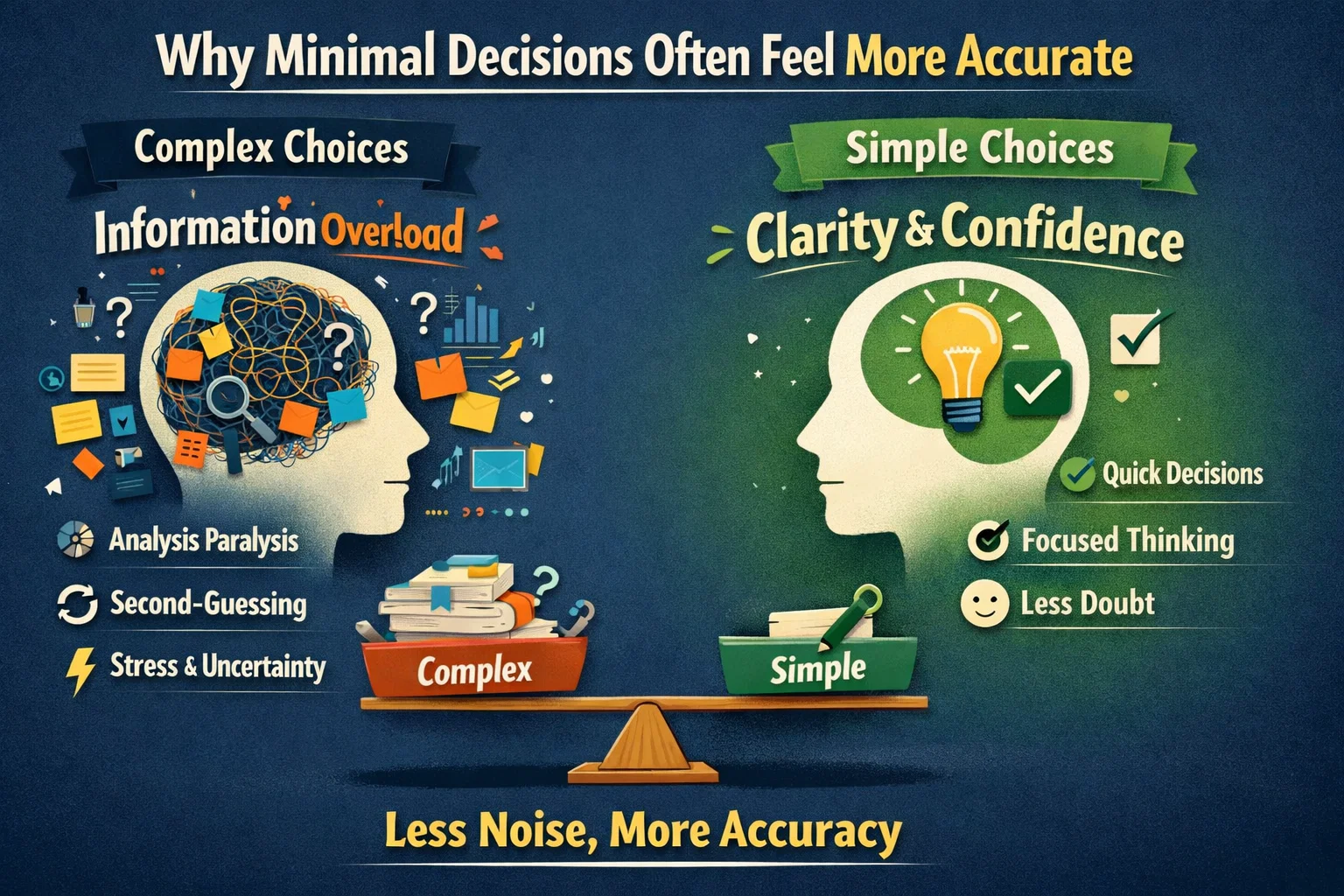
Minimal decisions reduce the amount of information your mind has to juggle. With fewer variables, you’re less likely to lose the thread of what matters, and more likely to notice the one or two cues that actually drive a good outcome.
This “accuracy feeling” often comes from clarity rather than correctness. When a decision is easy to explain, it also tends to feel trustworthy. In psychology, that’s closely related to processing fluency: ideas that are easier to process are often judged as more valid, even when they’re not.
The hidden cost of too many options
More options should mean better outcomes, but in real life it often creates decision fatigue. Every extra comparison taxes attention, patience, and working memory so the final choice is made with less energy than the earlier ones.
- Analysis paralysis: you keep researching because no option feels “safe enough.”
- Regret sensitivity: more alternatives create more imagined paths you didn’t take.
- Noise inflation: you start treating small differences as if they’re meaningful.
Minimal decisions avoid those traps by narrowing the frame: fewer comparisons, fewer “what ifs,” and fewer chances to overfit your choice to irrelevant details.
Heuristics: the brain’s shortcut system (and why it works)
A lot of “minimal decision-making” is really heuristics fast rules of thumb. They work well when the environment is stable and the signals are strong (for example, choosing the restaurant that’s consistently busy, or sticking with a brand that’s never let you down).
Minimal decisions feel accurate because they compress complexity into a simple rule and simple rules are easier to trust.
But heuristics are only as good as the assumptions underneath them. If the situation is new, high-stakes, or emotionally charged, the shortcut may feel clean while quietly missing critical information.
When “minimal” becomes a tool: designing better quick decisions
The goal isn’t to guess faster it’s to decide with fewer, higher-quality inputs. Here are practical ways to keep decisions minimal without becoming careless.
1) Use a two-criteria rule
Pick the two factors that matter most and ignore the rest. For a job offer, that might be growth + manager quality. For a purchase, it might be reliability + total cost of ownership.
2) Decide in advance what “good enough” means
Create a threshold, not a perfect target. Example: “Any laptop under $1,200 with 16GB RAM and a solid warranty is acceptable.” This stops endless incremental comparisons.
3) Separate “preference” from “prediction”
Ask: am I choosing what I like, or forecasting what will work? Minimal decisions are strongest when you’re clear which game you’re playing.
4) Use randomness only when options are genuinely equivalent
If two choices are truly close, a small nudge can help you move on. For low-stakes ties—like picking between two lunch spots using a coin flip can break the loop and reveal your gut reaction (you’ll often notice immediate relief or disappointment as soon as it lands).
Where minimal decisions can mislead you
Feeling accurate isn’t the same as being accurate. Minimal choices are most likely to go wrong when:
- The stakes are high: health, legal, safety, and major financial decisions deserve depth.
- You’re under stress: stress narrows attention and makes simple stories feel extra convincing.
- The problem is unfamiliar: you may not know which details are “signal” vs. “noise.”
- There’s hidden complexity: contracts, long-term commitments, and systems with delayed consequences.
FAQs
Q: Are minimal decisions always better than detailed analysis?
A: No. They’re better for low-to-medium stakes, repeatable choices, and situations with clear signals. Detailed analysis is worth it when consequences are significant or information is genuinely diagnostic.
Q: Why do quick decisions sometimes feel more confident?
A: Confidence often rises when your brain experiences low friction and a coherent narrative. That sense of fluency can boost confidence even if accuracy doesn’t improve.
Q: How can I tell if I’m simplifying wisely or just avoiding discomfort?
A: If you’ve identified the key criteria and can explain your choice in one sentence, that’s productive simplification. If you’re skipping essential facts because researching them feels stressful, that’s avoidance.
Conclusion
Minimal decisions often feel more accurate because they reduce cognitive load, cut through option overload, and lean on the brain’s preference for clear, fluent explanations. When the signals are strong and the stakes are reasonable, simplicity can genuinely improve outcomes not just your confidence.
The practical win is learning when to simplify and when to slow down: use a small set of criteria, define “good enough,” and treat quick tie-breakers as a way to move forward not as proof you found the one perfect answer.
