
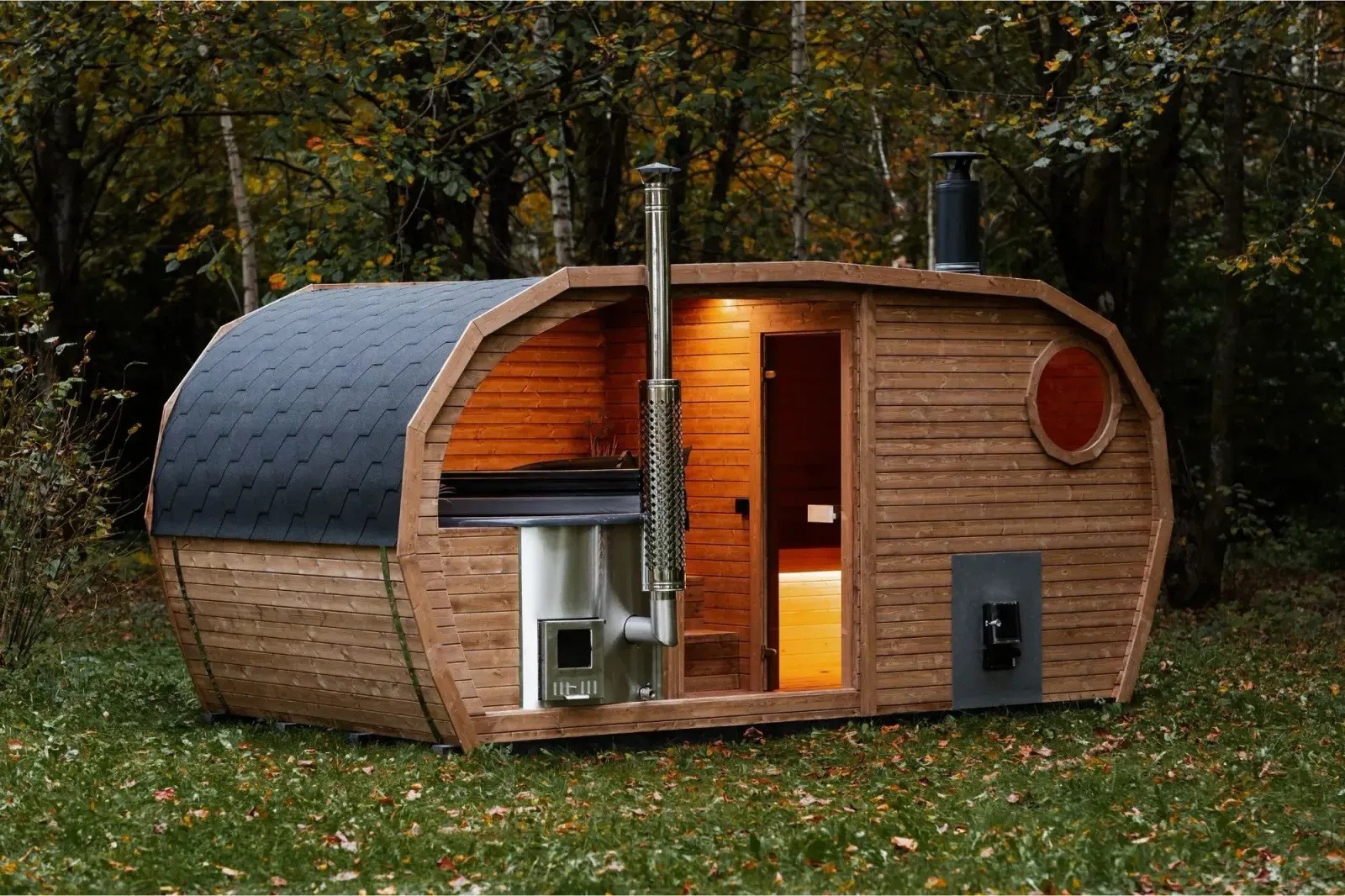
If you told somebody in Surrey five years ago you were planning to install a sauna in your backyard, that person would have probably pictured a dusty cedar box at the local leisure centre and wondered whether you were crazy. But that same conversation today might quite likely finish with them asking for a recommendation.
Outdoor saunas have simply become one of the biggest home wellness categories in the UK without really being seen. What was just a niche import from Nordic countries has become a big lifestyle change, with barrel saunas, cube pods, and panoramic cabins appearing in gardens all over the UK, from Cornwall to the Cairngorms. And unlike most wellness trends, this one isn’t slowing down at all.
The demand is even easier to prove when you start looking for it. Specialist retailers have really ramped up their importing operations, installers are fully booked several months in advance, and the British Sauna Society has been experiencing a yearly increase in its membership. So clearly, something did change.
From Fringe Ritual to Back Garden Fixture
The transition really intensified during the lockdown years when people after seeing their own homes decided that the garden was the new frontier. Garden rooms, pizza ovens, and hot tubs all got their time, but saunas have shown to be more durable than most.
One reason is cultural. Cold water swimming has become incredibly popular in the UK. There are even groups of people meeting before sunrise at reservoirs, lidos, and sea fronts all across the country. After regularly immersing yourself in nine-degree water, coming home to a hot room ceases to be seen as a luxury and starts to be perceived as a necessity.
Furthermore, mobile sauna operators contributed in a subtle yet significant way. Horseboxes that were converted and cabins on trailers started getting spotted at beaches in Brighton Margate Aberystwyth, and Tynemouth, thus introducing thousands of people to proper lyly for the first time. After experiencing it outdoors with the sea air filling your lungs, a gym sauna will never be the same.
Why the British Climate Actually Helps
There is a surprising fact hidden in this phenomenon. The damp, grey British climate does not prevent one from having an outdoor sauna; rather, it is the very reason that experiencing it feels so pleasurable here. In fact, a wood-fired or electric sauna heated to 85 degrees is the perfect contrast to a cold, wet November apogee. The smoke emerging from the cedar, the rain hitting the roof, the cold plunge outside after; here the weather significantly increases everything which makes the ritual so rewarding. In a warm country, a sauna is simply a consideration. In Great Britain, quite paradoxically, it is almost like the weather dictating your choice.
This difference in seasons also partly accounts for widely underestimated sauna usage generally. Purchasers are persuaded that they will use the sauna once or twice weekly, yet soon discover that they will be spending in the sauna four to five evenings a week, particularly during the autumn and winter seasons. Proximity to the sauna is a really key factor. Most people never feel a time or energy constraint when the cabin is only twenty feet away from the back door.
The Real Health Drivers Behind the Boom
The wellness discourse has profoundly changed and evolved in the last couple of years. Everyone don’t purchase saunas just because a celebrity has been spotted using one; rather they make such purchase decisions as the long-term Finnish research on heat exposure has been consistently making its way to the general public.
Using a sauna regularly is reportedly a good way to improve one’s cardio health, enhance the efficacy of workout recovery, treat insomnia, and generally increase one’s capacity to handle stress. Not one of these is still considered to be marginal. Family doctors talk about it. Physiotherapists talk about contrast therapy. Olympic-endurance athletes have been using the heat exposure method for years, and weekend runners and cyclists have recently started doing so as well.
But mental health is the other side of the coin. Spending less than twenty minutes in a heated cabin, away from the phone, screen, and any form of input, is probably something most people don’t do in fact. Many purchasers say it’s the only time during the day when their brains actually “switch off.” It is a very strong selling point in a country where, on average, people are spending more and more time with their phone screens.
What’s Changed in the Market
Hardware has gotten a lot better, and prices have fallen quite a bit without most people realizing it. A basic barrel sauna that might have cost eight or nine thousand pounds a few years ago could now be purchased for about half the price, and they will have better insulation, genuine Harvia or Huum heaters, and window glass that can stand up to British weather.
The variety of style options has increased as well. Naturally, barrels still sell quite a bit as they are not only visually appealing but also heat up quickly. On the other hand, cube saunas that have large glass walls have become the preferred choice of people who want to look out in the garden rather than at the wooden walls. Also, hybrid cabins that can be heated with both electricity and wood-fired heat are becoming quite popular especially among those who want the option of both with less inconvenience of chimney upkeep every weekend.
Specialist British suppliers have filled a gap that used to be occupied almost entirely by Nordic importers. Companies like Edenhut have built their reputations around delivering properly specified cabins with the kind of after-sales support that matters when something needs replacing in year three or year four. That shift towards domestic expertise has made ownership feel a lot less daunting for first-time buyers who don’t fancy shipping disputes with a factory in Latvia.
Installing One Without the Headaches
The practical aspects are mainly where a lot of people start to worry, quite often very unnecessarily. The majority of residential outdoor saunas in the UK are considered to be under permitted development rights, which means that no planning permission is required if the construction complies with the size and siting rules. Separate cabins less than 2.5 metres at the eaves and located more than two metres from a boundary are typically acceptable.It should be noted that listed buildings and conservation areas are the exceptions that definitely require a check
Electrical power supply is a more significant concern. A proper six-kilowatt heater demands a dedicated thirty-two-amp power supply, which almost invariably means a professional electrician installing armoured cable from the consumer unit. This is not a DIY job and it’s not cheap either, but it’s the most important single thing to do correctly. Lack of power supplies is the main reason for the owners’ disappointment in their very first year of ownership.
The location is another consideration that deserves a thorough thought. Great gardens generally feature a spot that is private to some extent, not too steep, and still within a reasonable distance from the house so that it is convenient even on the coldest Wednesday night. If you need to walk thirty metres in slippers to get there, you probably won’t do it, and a sauna that is not being used is simply a very costly shed.
A Trend With Staying Power
Unlike many wellness fads, the outdoor sauna craze is supported by very real foundations. The science backing it is sound, the cultural change regarding cold water and recovery is firmly in place, and the equipment has finally reached a level of quality to making the investment worthwhile.
In fact, it’s among the rare home additions that generally see usage increase rather than decrease with time. Those buyers who doubted the idea at first ultimately become the ones recommending it to their friends, leading to such a smooth and consistent growth pattern. For a nation that had for a long time equated wellness with pricey gyms and leisure centre memberships, the idea of having a private cabin in the garden is radically different; and for quite a few British households in 2026, it’s the thing that has caught on.
