
Summer heat can be oppressive. When things get too hot indoors, you probably reach for the AC remote. But wait! Did you know there might be a better option right next to it? Air coolers have been popular for decades, and they’re rising in popularity again.
In fact, more homeowners are tossing their old AC units to upgrade to these simple devices. After reading why, you might consider doing the same.
Save Money
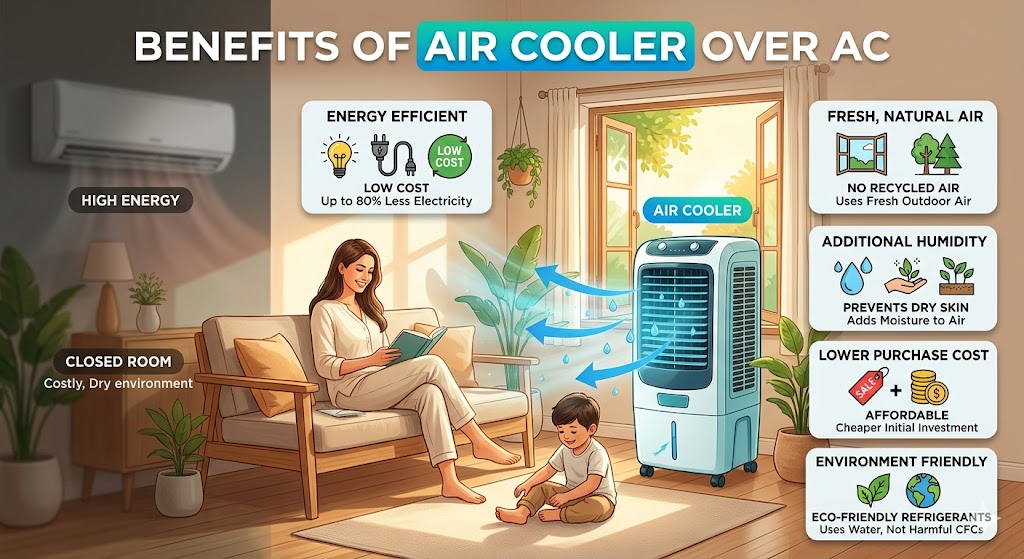
Alright. Let’s start with the most popular reason: price. Air conditioners are expensive. They cost hundreds (or even thousands) of dollars to purchase and install. Then they consume copious amounts of electricity to run. Air coolers cost far less money. You can buy a fully functional air cooler for less than $100. Many high-quality models are less than $300.
Where you’ll really notice the difference is on your electric bill. Air conditioners require compressors and refrigerants and all kinds of mechanical parts that require power every hour they run. Coolers utilize nothing but a fan and a water pump. That’s it. An air cooler consumes up to 80 percent less electricity per hour than a standard AC unit. Run it all summer and you’re looking at saving hundreds of dollars.
Better for the Environment
Speaking of refrigerants, did you know traditional air conditioners use chemicals that can harm the environment? When they leak out (and they will eventually leak), they can cause ozone depletion and accelerate global warming. Air coolers don’t use refrigerators at all.
They work by a process called evaporation. When air passes through water-soaked cooling pads inside the cooler, the water absorbs heat from the air and evaporates. As a result, the temperature lowers before it vents into your living space. No chemicals. No risk of damaging the environment. Just good old water and airflow working as nature intended. If you want to reduce your carbon footprint, upgrading to an air cooler is one tangible way to do it.
Cooler Air
Here’s a little-known fact about air conditioning: it sucks the humidity right out of the air. Have you ever noticed how dry your mouth and skin feel after spending time in an air-conditioned building? AC deliberately removes moisture from the air to help it cool faster. But that can leave your indoor air feeling dry and uncomfortable. It can exacerbate skin, throat, and eye irritation.
Air chillers don’t have that problem. Since they cool the air via evaporation, they release water vapor into the air as they run. The effect is a cooler, more comfortable breeze that hydrates you instead of drying you out. Many users love this feature, particularly if they work from home or tend to spend all day in a single room. If you experience dry skin or discomfort during air-conditioned months, an air cooler could help alleviate those symptoms.
Easy Installation
It takes a fair amount of work to install a window AC unit. You have to secure it in the window frame, seal all the edges, and route the drainage tube. Central air conditioning requires expensive professional installation that can take days. Even if you own your home, you might be renting your windows. That could prevent you from installing anything at all without your landlord’s permission.
Air coolers don’t need installation. Just add water, plug it into a power source, and turn it on! Many models even come with wheels so you can roll them from room to room. Want to have it in your bedroom at night and the living room during the day? Easy! Move it where you please. No extra installation. No expensive contractors. That kind of convenience doesn’t come standard with most AC units.
Low Maintenance
Air conditioners require yearly maintenance by a professional. They will need to check your filters, refrigerant levels, and clean the coils. Something breaks or otherwise goes wrong with the compressor or refrigerant; it’s time to pay for service. You’re looking at $100 to $500 for repairs, depending on the problem and your area.
Air coolers need hardly any maintenance at all. Other than wiping down and emptying the water tank, all you need to do is replace the cooling pads every year or so. That’s it! Pads are very affordable and you can buy them online or at the local hardware store. No special skills needed. No service calls. Just pump some water in once a week and you’re good to go.
Great for Dry Climates
Air coolers work best when the climate is hot and dry. That makes them ideal for locations or homes with low humidity. If you live in the desert or a part of Texas that doesn’t see much rain in the summer, air coolers can be just as effective at cooling your space as AC. Houston is humid, so keep that in mind before purchasing. However, if you live in a dry climate or are looking to cool a semi-open area like a workshop, garage, or patio, air coolers often outperform competitors.
Safer for Children and Pets
Traditional air conditioners have lots of sharp edges. Some have electrical components you really don’t want kids (or pets) to touch. Others still use refrigerant lines that could potentially leak if damaged. Air coolers have a much lower risk of any hazardous accidents. They have a simple fan and water tank. Most models come with protective grilles around the fan motor itself. Many have automatic shut-off should they get tipped over.
They also run incredibly quiet and don’t heat up on the outside like AC units do. If you have curious toddlers or pets who like to investigate everything that moves, you’ll love the peace of mind that comes with an air cooler.
Air Cooler Case Study: Slash Cooling Bills
Emma resided in a suburban neighborhood that had dry weather. Summers were usually hot and temperatures would exceed 30 degrees Celsius.
To keep her house cool, she had one window air conditioner. It cooled her small condo nicely but her electric bills were high in summer.
Emma thought there must be a more cost-effective solution. She decided to purchase an air cooler for the main living space and use her AC sparingly.
She put her air cooler near an open window for better airflow. She began using the air cooler during the day instead of her air conditioner.
After several weeks, she began to see results:
- Emma’s electric bill went down by about 40% each month
- Her home felt more comfortable with no longer dried out air
- She only turned on her air conditioner when it was extremely hot
The downsides were small. She had to refill the water tank and keep windows open for better ventilation. It was well worth it for the increased comfort and lower energy bills.
Final thoughts: Emma was able to cut down on energy costs and live more comfortably by using an air cooler instead of her AC.
Takeaway: Air coolers offer an inexpensive and effective alternative to air conditioners.
Link: https://www.scribd.com/document/426692621/improvise-anteena
Air Cooler FAQs
1. Are air coolers less expensive than AC units?
Yes. Air coolers are much less expensive to buy and run.
2. Do air coolers really help you save on electricity?
Yes. An air cooler uses 70–80% less electricity than a traditional AC unit.
3. Are air coolers healthier for you?
They can be. Air coolers add moisture to dry climates and can help prevent dry skin, eyes, and throat.
4. Do I need to have my air cooler installed?
No. Air coolers are portable and ready to use. Simply add water and turn on.
5. Can I use an air cooler instead of my window AC?
Not necessarily. Air coolers are only ideal for dry climates.
6. Are air coolers safe around children and pets?
Yes. Air coolers are safer than AC units. They don’t contain refrigerant and have fewer sharp or hazardous parts.
Final Words
Air coolers will never replace AC units for every person and every situation. However, they provide sufficient cooling for most homes on hot summer days. And they do so at a fraction of the cost. You’ll spend less money buying it, running it, and maintaining it for years to come. It’s easier on the environment and easier on your body. It is portable, simple to set up, and safe for your entire family. Next time your AC breaks down, consider replacing it with an air cooler instead.
