
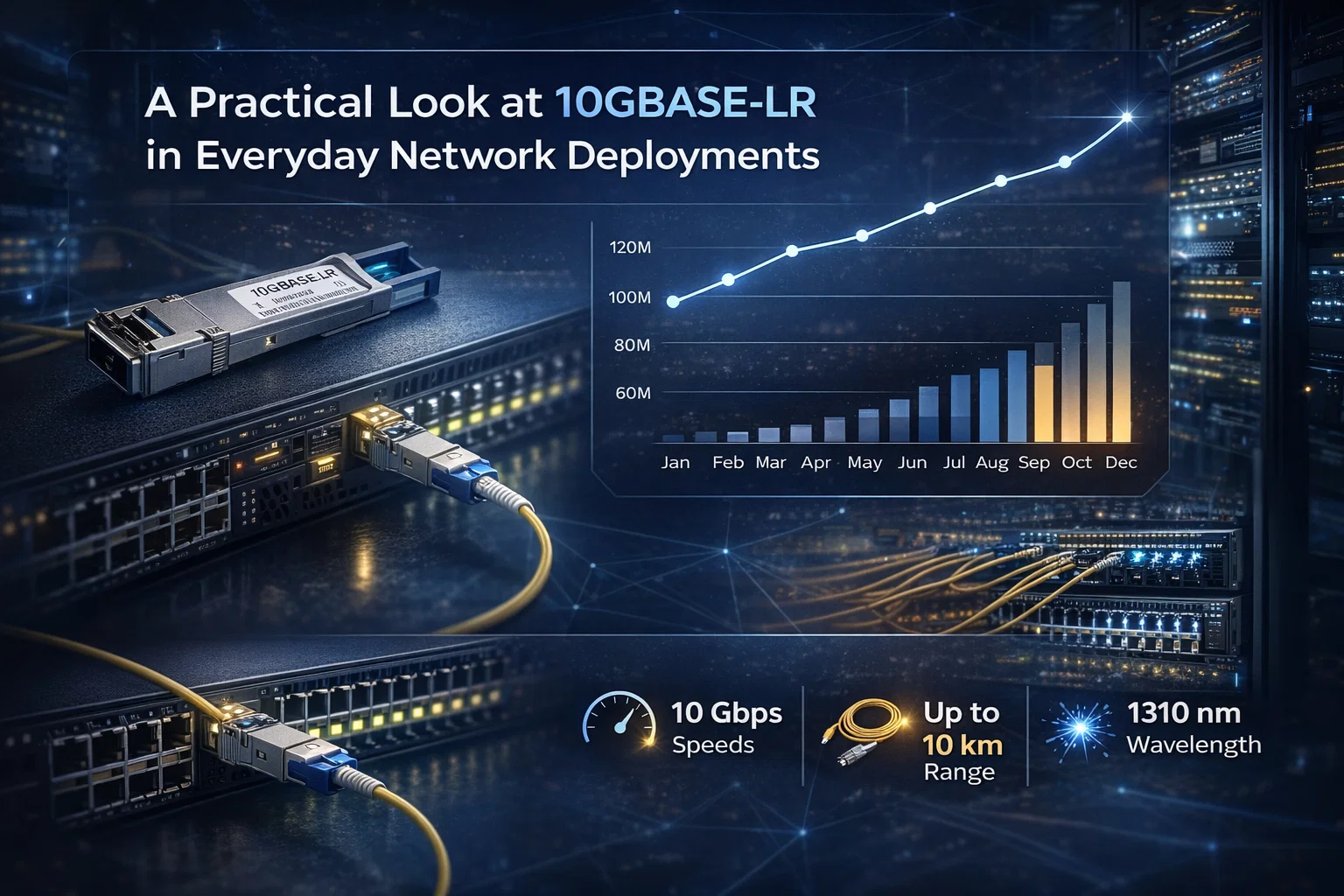
When people talk about 10-gigabit fiber links, 10GBASE-LR usually comes up sooner or later. Even with faster technologies widely available, LR modules continue to appear in real networks because they solve a very practical problem: stable 10G connectivity over single-mode fiber without complicated planning. Defined under the IEEE 802.3 Ethernet specification, 10GBASE-LR supports transmission distances up to 10 kilometers, making it a natural choice for campus networks, metro access layers, and enterprise backbone links.
Despite the growth of 25G and 100G networks, many organizations still rely on 10G infrastructure. Instead of replacing everything at once, network teams often expand existing systems step by step. In those environments, LR modules tend to be the simplest and safest option because they are predictable and widely compatible. Equipment from different vendors usually works together without much tuning, which reduces the time spent troubleshooting.
Why 10GBASE-LR Remains a Reliable Option
One of the main reasons LR modules remain popular is consistency. Engineers generally know what to expect when deploying them. The technology has been around long enough that installation guidelines are clear, component quality is mature, and performance is well understood.
Unlike short-reach multimode optics, LR modules operate on single-mode fiber. Single-mode cabling introduces less signal loss and allows longer distances without repeaters. This characteristic makes LR modules suitable for buildings spread across a campus or connections between distribution points in a city.
Another practical advantage is that single-mode fiber installed for 10GBASE-LR can often be reused for future upgrades. Many networks originally built for 1G or 10G later transition to 25G, 40G, or 100G using the same fiber plant. In that sense, LR deployments are often viewed as a long-term infrastructure investment rather than a temporary solution.
From a daily operations perspective, LR modules also tend to behave predictably under varying conditions. Temperature changes, cable routing adjustments, or patch panel reconfigurations rarely cause unexpected failures if the optical budget is properly planned. This stability is one reason LR links are frequently chosen for critical connections.
Deployment Scenarios Where LR Works Best
In enterprise environments, LR modules commonly connect core switches to aggregation layers. These links often run between equipment rooms located in different buildings or floors. Distances typically fall within a few kilometers, well inside the LR operating range.
Telecom access networks also make frequent use of 10G LR optics. Service providers often deploy 10G links between aggregation nodes where moderate bandwidth is required but ultra-high speeds are not yet necessary. LR modules provide enough reach to span urban areas without introducing unnecessary cost.
Another common scenario is data center interconnection within a metropolitan area. While large cloud providers often move directly to 100G or higher speeds, smaller facilities may continue operating at 10G for years. LR optics provide a dependable way to connect sites without complex optical transport equipment.
Lab environments and test networks also benefit from LR modules. Engineers building prototypes or evaluation setups often prefer technology that behaves predictably. LR optics reduce variables and allow teams to focus on system testing rather than optical troubleshooting.
Operational Considerations
Although LR modules are straightforward to deploy, a few planning steps still matter. Optical power levels should match the link distance, especially for shorter runs. Extremely short single-mode links can sometimes produce excessive receive power, which may require optical attenuators.
Connector cleanliness is another important factor. Single-mode optics use narrow cores, so contamination can quickly affect signal quality. Regular inspection and cleaning procedures help maintain stable performance over time.
Compatibility testing is usually simpler than with newer technologies, but it is still worth confirming interoperability before large deployments. Even standardized modules can behave slightly differently depending on firmware or hardware revisions.
Energy consumption is relatively modest compared with higher-speed optics. For networks with hundreds of ports, this difference can noticeably reduce cooling requirements and operating costs.
A Technology That Still Fits Real Networks
While the industry continues pushing toward faster speeds, not every network needs immediate upgrades. Many organizations prioritize stability and predictable costs over maximum bandwidth. For those environments, 10GBASE-LR remains a practical and sensible choice.
The combination of long reach, stable operation, and compatibility keeps LR modules relevant even as newer technologies emerge. Instead of disappearing, LR optics have settled into a role as dependable building blocks for medium-scale networks.
In real deployments, technology rarely disappears overnight. Systems evolve gradually, and proven solutions often remain in place longer than expected. 10GBASE-LR is a good example of that pattern — not the newest option available, but still one of the most reliable ways to deliver consistent 10-gigabit connectivity.
