
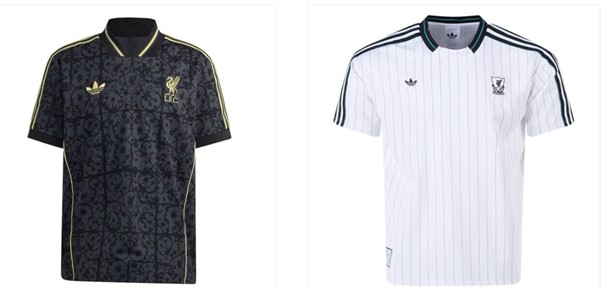
If you peek into any serious football shirt collection, you’ll almost always spot Liverpool jerseys at or near the top of the heap, not infrequently those with the heftiest price tags too. Vintage Liverpool shirts have been rising in value continuously for many years, and the pattern of growth has become very marked since the early 2020s. A shirt that was sold for 80 euros five years ago can easily fetch three or four times that amount on the resale market today.
There is a particular combination of factors that explains this, and it’s not simply a matter of nostalgia and speculation. The long history of Liverpool, the stylistic aspects of their traditional kits, and on top of that the extent of their international fanbase, provide the basis for a collector’s market which keeps discovering new buyers.
Here is what really leads the rise, and which jerseys are getting the highest figures.
A Trophy History That Never Runs Out of Moments
During the late 1970s and 1980s, Liverpool’s golden run yielded a number of the most famous English football teams that have ever existed. Four European Cups from 1977 to 1984, two league titles in a row, and a team that was made up of players who turned into legends far beyond Merseyside are some of the highlights. Fans still watching the replays on YouTube can associate every shirt from that time with the respective trophies and matches.
In 1989, the Hillsborough tragedy and its aftermath gave certain Liverpool shirts a meaning that is beyond football. Those kits have been linked to one of the darkest periods in the club’s history and the battle for justice that lasted for a long time. Collectors take those shirts very seriously, and the emotional intensity is one of the factors that determine their worth.
Then the 2005 Champions League final in Istanbul happened. Liverpool managed to come back from being three goals down at halftime and beat AC Milan on penalties. The Reebok-made kit from that night featuring the Carlsberg sponsor is now considered one of the most desired modern jerseys in the collector market. The prices for authentic match-era copies have greatly increased over the years, especially for those associated with Steven Gerrard.
Iconic Designs That Age Well
The identity of Liverpool’s shirts has remained largely unchanged visually and has been remarkably preserved through the decades. They almost always use red as the base color, sometimes with different shades, collar types, and arrangements of the sponsor logos. But fundamentally, the form stays familiar through time.
The Liverpool style of the 1970s and 80s under the Umbro brand gave us some of the clearest interpretations of the Liverpool identity – minimalistic styles, traditional V-necks or polo collars, and the Liver bird emblem visibly positioned on the chest. The introduction of the Hitachi sponsor in 1979 marked Liverpool as one of the pioneering English top-flight clubs to display a sponsor on their kit. This not only gave Liverpool kits a new look but also made these kits iconic beyond football.
Another very desirable item for collectors is the Candy-sponsored Adidas tops from 1988 to 1992. The striped pattern, the prominent Candy labeling, and the connection with the last Liverpool championship team before 2020 are factors that help maintain demand. An original, unworn 1989-91 home shirt can fetch several hundred euros nowadays.
A Fanbase That Reaches Everywhere
Liverpool is one of the biggest football clubs in the world with the largest fan base globally and because of that large fan base, in a way, smaller clubs cannot compete, they push the market of collectors’ items to such an extent. Fans’ clubs are spread out through every continent and in cities such as Tokyo, São Paulo, Lagos, and Jakarta, fans have been growing up by watching Liverpool games and at the same time, getting emotionally connected to certain players and certain eras.
This geographical distribution always leads to a demand. A vintage Liverpool jersey that one can see for sale in Manchester will, within a few hours, attract not only bids from buyers in South Korea, Norway, Australia, and the US but also the attention of others who are looking for a certain year, a certain size, a certain player name on the back, etc.
Besides football, the club’s connection with its working-class roots and the city of Liverpool as a sort of family is also a reason why collecting to some extent, also has a cultural aspect. For many of the purchasers, owning a vintage Liverpool shirt is not just about football but it is also about identifying with a certain ethos that both the club and the city stand for.
The Supply Problem Driving Prices Up
Really, the most challenging aspect of putting together a collection of vintage Liverpool shirts is that the majority of them probably don’t exist anymore in a condition worth considering as “good”. To be honest the fabric of football shirts of the 70s, 80s, and early 90s wasn’t made for a lifetime. Heavy cotton blends got cracked and faded, sponsors on the shirts that were heat-pressed got peeled, and most of the kits from this time were worn very hard, washed very aggressively and in the end thrown out.
It is truly rare to find original shirts that have been kept in mint or near-mint condition. In fact tagged unworn examples from specific title-winning seasons are nowadays treated more like sports memorabilia than just clothing. Auctioneers have started dealing with high-end vintage Liverpool shirts in the same manner as match-worn jerseys, and the prices reflect this.
Even the ones that are quite worn still fetch a price because the demand is continuously outpacing the supply. As every year passes, the number of collectors grows, and the vintage shirt pool gets smaller at the same time because these shirts get placed into private collections that don’t see the light of day for decades.
This is also why the market for high-quality retro reissues has exploded. Fans who want the look of a 1989 Candy shirt or a 1984 European Cup final jersey without spending 500 euros on an original can turn to licensed retro versions that replicate the design accurately. If you want to see current and classic Liverpool kits available at SoccerLord, specialist retailers stock both current season shirts and retro-styled reissues that hit that nostalgic sweet spot.
What Makes a Liverpool Shirt Worth Collecting
Condition really is everything. A shirt with perfect stitching, original labels, crisp sponsor printing, and no yellowing or stretching is going to get the seller several times the amount of the same shirt with damage or fading. Collectors even pay a lot more for shirts that still have the feel as if they were just taken out of the factory.
Historically, it also matters. Clothes that come with documented history -worn at a specific match, signed by a player, connected to a particular season -will increase in value tremendously. Even jerseys unsigned from historic seasons like 1983-84, 1988-89, or 2004-05 fetch high prices only because of what those kits stand for. Size influences value in a way that novice collectors might not expect. Well-preserved adult medium and large shirts are the most desirable among most buyers, whereas very small or very large sizes may be more difficult to sell even if the shirt itself is rare.
Why the Trend Isn’t Slowing Down
There is nothing in the present direction that indicates vintage Liverpool prices will lessen anytime soon. The quantity is continually getting smaller, the worldwide fanbase is endlessly increasing, and younger collectors who are newly entering the market are directing demand to the eras that the older collectors had already deserted.
Let’s say you have a Liverpool original jersey from the 1970s, 1980s, or 1990s and it has been kept in very good condition; you are probably holding onto an item whose value will most likely increase in five years’ time as compared to now. Additionally, if you are considering starting a collection, the sooner you decide on particular years and designs, the less you will regret the prices you paid when looking back on it later.
