
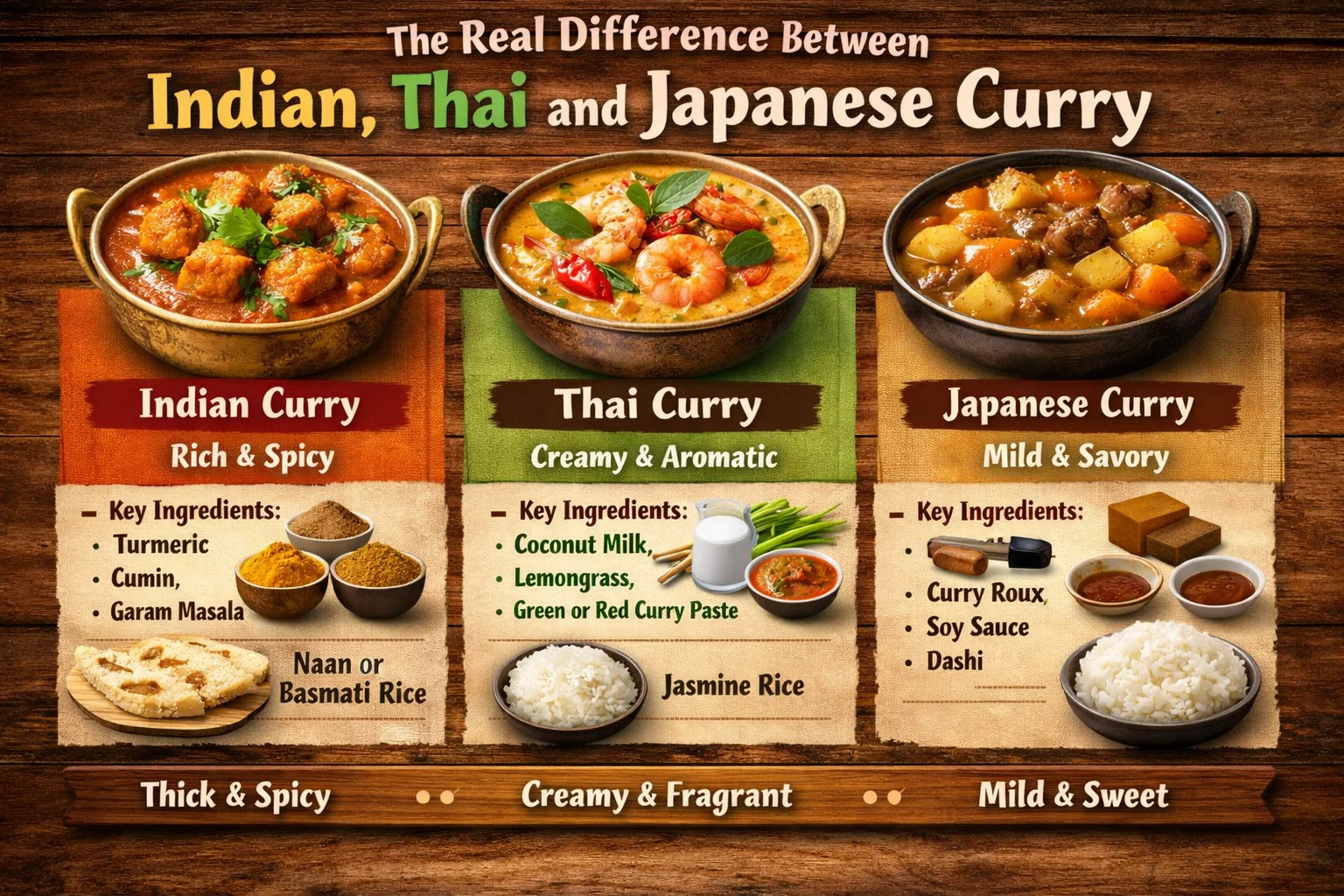
Choosing the best curry sounds simple until you put the three major contenders side by side. Indian curry, Thai curry and Japanese curry all carry the same label in English, yet they behave like very different foods. They are built differently, served differently and satisfy different cravings. One leans on deep spice layering, one on sharp freshness and one on thick comfort. That is why people often argue about curry without really talking about the same thing.
Indian curry offers range on a scale the other two do not match. It can be dry, saucy, fiery, smoky, creamy, sour or earthy depending on region, technique and ingredients. Thai curry tends to present itself more clearly. You usually taste freshness quickly, then heat, then sweetness, then coconut or herb notes. Japanese curry speaks in a quieter voice. It is thicker, softer, sweeter and designed less to surprise than to settle you. It is not trying to impress with spice detail. It is trying to be dependable.
That difference matters because “best” depends on what kind of meal a person wants. Some people want complexity and variation. Some want brightness and a sense of lift. Some want food that feels steady, filling and familiar. Curry is one of those categories where personal mood matters almost as much as culinary skill.
The question also becomes harder because the word curry itself is broad and slightly misleading. In India, many dishes grouped under the English term “curry” have their own names, histories and regional identities. In Thailand, curry often means a paste-led dish with a specific colour and herb balance. In Japan, curry usually refers to a roux-thickened sauce served with rice, often with fried cutlet or stew-style vegetables. These are not minor variations of one template. They are separate traditions that happen to share a label in global conversation.
A fair comparison, then, should not ask which one is objectively superior. It should ask what each one does best, why people return to it and where it stands out on the plate. When you look at curry through flavour, texture, effort, comfort and cultural purpose, the answer becomes more useful. The best curry is rarely the one with the strongest reputation. It is the one that matches the moment.
Indian Curry, Built for Depth and Variety
Indian curry is the hardest of the three to reduce to a single style. That is both its strength and the reason debates about it often go nowhere. An Indian curry from Punjab has little in common with a coconut-based curry from Kerala except the broad fact that both are seasoned dishes served with rice or bread. Even within one region, the same cook may produce different results depending on whether the dish starts with onions browned slowly, whole spices tempered in oil or a yoghurt base handled carefully to avoid splitting.
What makes Indian curry stand apart is layering. A good Indian curry rarely tastes like one loud note. It unfolds in stages. First comes the fat carrying aroma, often oil or ghee. Then come whole or ground spices, each doing a different job. Cumin adds warmth, coriander brings citrusy earthiness, turmeric gives bitterness and colour, chilli provides heat, fenugreek adds a faint edge, cardamom can lift sweetness and garam masala often enters later to deepen aroma rather than raw heat. The result is not just spice, but structure.
Technique matters as much as ingredients. Browning onions properly can shape the whole dish. Cooking off ginger and garlic without burning them affects balance. Toasting spices too long can make them harsh, while undercooking them can leave the curry flat. Tomatoes may bring acidity, yoghurt may soften and enrich, cream may round the edges, ground nuts may add body and pulses can turn the dish from side element to full meal. Indian curry rewards patience because small decisions stack up.
Its range also gives it the broadest personality of the three curry traditions in this comparison. Butter chicken is smooth, rich and mild by many standards, but a vindaloo pushes vinegar, chilli and sharper edges. Rogan josh focuses on meat and aromatic warmth. Chana masala uses chickpeas to build substance and texture. Sambar behaves differently again, leaning toward lentils and tang. Fish curries in coastal regions bring tamarind, mustard seeds or coconut into play. If someone says Indian curry is the best, they may be praising a whole universe rather than a single dish.
That breadth makes Indian curry the strongest contender for people who value complexity and choice. It gives more routes in. A vegetarian can eat brilliantly across Indian curry styles without feeling like they are choosing a lesser option. A meat eater can find curries that suit slow-cooked lamb, chicken on the bone or minced meat. Someone who loves bread can pair a curry with naan, roti or paratha. Someone who prefers rice has equally strong options. Indian curry does not force one mode of eating.
It also carries more contrast between home cooking and restaurant cooking than many people realise. Restaurant curries in Britain often represent a narrow and adapted slice of the wider Indian tradition. They tend to favour thick gravies, familiar names and crowd-pleasing richness. Home-style Indian curries often feel lighter, sharper and more specific. They may rely less on cream and sugar and more on spice balance, onions, lentils or vegetables. That gap affects how people judge Indian curry. A person who has only eaten takeaway versions has not met the whole category.
The weakness of Indian curry, if it has one, lies in accessibility. For a new cook, it can feel demanding. A proper spice collection costs money. Recipes can involve several steps. Timing matters. Regional differences can confuse people who want one clear answer. Even eating it can demand more attention. On a crowded menu, the choice between korma, jalfrezi, dhansak and madras means little unless you already know the pattern. Indian curry often asks for curiosity.
Still, when people talk about the best curry in terms of flavour depth, Indian curry has a serious claim. It can be comforting, but comfort is not its only strength. It can also be precise, layered and memorable in a way that keeps changing from one meal to the next. No other curry tradition in this comparison offers that level of internal diversity. If the best curry is the one with the most room for discovery, Indian curry wins.
Thai Curry, Built for Freshness and Contrast
Thai curry takes a different route entirely. Where Indian curry often builds depth through dry spices and long layering, Thai curry tends to announce itself quickly through fresh aromatics and paste-driven intensity. Lemongrass, galangal, kaffir lime leaf, chillies, garlic, shallots, shrimp paste and fresh herbs create flavours that feel bright and immediate. Coconut milk often rounds the dish, but it does not bury the sharper edges. A Thai curry should not taste flat or heavy. It should taste alive.
This is why Thai curry often makes the strongest first impression. The flavours rise fast. Green curry hits with herb freshness and heat. Red curry tends to feel deeper and slightly rounder. Yellow curry often comes across as softer and warmer, partly due to turmeric and spices, and in some cases it shows outside influence more clearly. Massaman, although often grouped with Thai curries, moves in a richer and more spiced direction, with peanuts, potatoes and a gentler pace. Even within Thai curry, there is enough variation to avoid repetition, but the overall style remains more recognisable than the Indian category.
Balance is the heart of Thai curry. Good Thai cooking often relies on tension between spicy, salty, sweet and sour elements. Fish sauce adds savoury force. Palm sugar softens and rounds. Lime sharpens. Coconut milk smooths. Chillies drive heat, while herbs keep the dish from becoming dull. That balance gives Thai curry a strong advantage for people who dislike food that feels too dense. Even a rich Thai curry often leaves a cleaner finish than a heavy cream-based curry from elsewhere.
Texture plays a major role too. Thai curry is usually looser than Indian curry and much looser than Japanese curry. It sits between soup and sauce depending on the dish. That changes how it is eaten. Rice absorbs rather than merely supports it. Vegetables often retain more bite. Meat is usually cut for quicker cooking. The result feels dynamic rather than slow. A Thai curry can be filling, but it usually still carries movement on the palate.
Thai curry also suits modern eating habits well. It works for people who want bold flavour without a long, heavy meal. It often feels more suited to warm weather. It can include vegetables in a way that feels natural rather than dutiful. It is easy to order when you know the colour or style you like. In many restaurants, it arrives looking clearer and cleaner than other curries, with visible herbs, distinct ingredients and a lighter sheen. That visual clarity helps its appeal.
At home, Thai curry can also be easier to manage than Indian curry, depending on the cook. Good ready-made curry pastes shorten the process. Coconut milk gives a dependable base. Chicken, prawns, tofu and vegetables all work well. Jasmine rice is straightforward. A home cook can produce a satisfying Thai curry with fewer separate steps than many Indian recipes demand. That makes Thai curry attractive to people who want a big return for moderate effort.
Its weakness is that it offers less comfort in the thick, slow sense. If someone wants a meal for a cold evening, Thai curry may feel too sharp or too light unless they choose something like massaman. Thai curry also depends heavily on freshness. If the herbs are tired, the paste weak or the balance off, the dish loses its edge quickly. There is less room to hide mistakes. Too much sugar, too much coconut milk or not enough acid and the curry starts to drift.
Thai curry may also feel narrower to those who crave depth over brightness. That does not mean it lacks sophistication. It means its sophistication works differently. It impresses through clarity, contrast and lift rather than through long spice echo. Some people hear that flavour more easily. Others want the slower build of Indian curry or the steadiness of Japanese curry.
If the best curry is the one that delivers the cleanest and most vivid flavour profile, Thai curry makes the strongest case. It offers energy, colour and balance without needing to be complicated on the plate. It is the curry most likely to win over someone who thinks curry is always heavy. It proves that richness and freshness can live together.
Japanese Curry, Built for Comfort and Reliability
Japanese curry enters the discussion from a very different angle. It is less concerned with spice complexity and less dependent on herb freshness. Its appeal lies in texture, warmth and consistency. Japanese curry is thick, smooth and usually mild, though heat levels vary. It is often built from a roux, sometimes bought in blocks, and combined with onions, carrots, potatoes and meat to make a sauce that behaves more like a stew than a sharp curry. Served over rice, it becomes a complete and focused meal.
This style has enormous strengths. First, it is clear about what it wants to be. Japanese curry is comfort food. It does not pretend otherwise. It fills the stomach, carries gentle sweetness and takes well to routine. Many people love it because it feels stable. Children can eat it. Adults return to it after long days. It works in homes, school canteens and specialist curry chains. It also pairs neatly with fried items such as katsu, croquettes or sausages. That pairing of crisp exterior and soft curry sauce is one of the format’s great successes.
Second, Japanese curry is highly approachable. Someone nervous about chilli or strong spice often finds Japanese curry easy to like. The heat is often lower, the sauce is thicker and the flavours are easier to read. Apples, honey, stock, onions and roux all help create a rounded taste that does not demand much from the eater. That makes it one of the easiest curries to introduce to people who say they do not like curry at all.
Its structure also suits modern home cooking. The method is forgiving. The ingredient list is manageable. The result holds well and often tastes better the next day. It is a practical curry. You can batch-cook it, reheat it and serve it with little fuss. In that sense, Japanese curry may be the most useful of the three. It asks the least and delivers dependable comfort every time.
This is also why some people dismiss it too quickly. They confuse simplicity with inferiority. Japanese curry does not compete by offering the spice maze of Indian curry or the aromatic burst of Thai curry. It competes by being deeply satisfying in a different way. The thickness matters. The mild sweetness matters. The orderly plate of rice and curry matters. It is one of the few curries where the pleasure often comes from repetition rather than surprise.
Still, its limitations are real. People seeking complexity may find it blunt. Those who enjoy intense chilli, sharp acidity or strong herbal notes may feel it lacks lift. Because it is so tied to comfort, it can seem predictable after several meals in a row. It also depends heavily on texture. If the sauce is too thin or the roux too heavy, the whole dish can feel clumsy. Japanese curry succeeds when it is smooth, balanced and properly integrated.
In restaurant settings, Japanese curry also occupies an interesting space. It rarely performs the same social role as an Indian meal with several dishes on shared restaurant tables, or a Thai meal where multiple plates interact with each other. Japanese curry is more self-contained. It often arrives as one complete plate, organised and direct. That makes it less theatrical, but often more focused.
If the best curry is the one most people could eat often without strain, Japanese curry may win. It is the least demanding and perhaps the most dependable. It does not aim to dominate the meal with complexity. It aims to make sense on an ordinary day. That is a serious culinary achievement, not a lesser one.
So, Which Curry Is Actually the Best
The honest answer depends on the standard being used. If the measure is complexity, Indian curry leads. No other contender in this comparison has such range, such depth or such internal diversity. It can keep a serious eater occupied for years and still reveal something new. It suits people who like flavour that unfolds slowly and rewards attention.
If the measure is freshness and balance, Thai curry takes the crown. It delivers contrast better than the others and often feels the most vivid from the first bite. It is ideal for those who want spice without heaviness, richness without fatigue and a meal that still feels lively at the end.
If the measure is comfort and repeatability, Japanese curry wins with ease. It may not be the most intricate, but it is deeply satisfying in a practical, honest way. It works on tired evenings, rainy days and ordinary lunches. It makes fewer demands and gives a lot back.
So the best curry is not one universal champion. It changes with context. On a cold night, Japanese curry may beat both rivals. When you want a dinner that feels layered and absorbing, Indian curry may be unmatched. When you want something aromatic, sharp and full of movement, Thai curry may be the obvious choice. Asking for one permanent winner strips away what makes these curries worth eating in the first place.
A better question is this: what do you want your curry to do? Do you want it to challenge your palate, refresh it or calm it? Do you want to explore, wake up or settle down? Indian, Thai and Japanese curry each answer one of those needs brilliantly. That is why the debate never ends. Each one is the best at being itself.
For my money, Indian curry edges ahead if the conversation is about overall greatness, because its range is so wide and its best versions are so rewarding. Thai curry comes close because of its clarity and balance. Japanese curry takes third place only in a competitive sense, not because it lacks merit, but because it plays a narrower role. Yet on some days that narrower role is exactly what makes it the best thing to eat.
That is the real strength of curry as a global category. It is not one dish fighting for one title. It is three strong traditions solving hunger in three different ways. Indian curry offers depth. Thai curry offers brightness. Japanese curry offers comfort. Pick the one that fits the moment, and you will probably think it is the best.
