
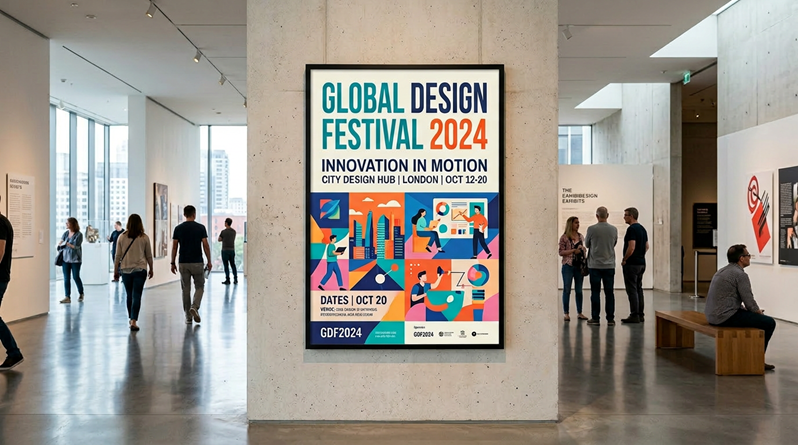
Most multi size poster campaigns do not collapse because of one obvious mistake.
They unravel quietly.
An A0 poster looks strong in a window. The A1 version feels slightly weaker in the corridor. The A3 copy on the noticeboard looks crowded. Nothing is technically wrong, yet the campaign no longer feels like a single message. People notice it without knowing why.
That loss of consistency is not accidental. It is structural.
Poster sizes are not just measurements. They change how design behaves, how colour is perceived, and how information is read. When those differences are ignored, campaigns drift apart even when the files started from the same artwork.
The False Comfort of “Same Design, Different Size”
Design software encourages a dangerous assumption.
If the layout scales cleanly, the result must remain consistent.
In print, this assumption fails almost immediately.
A layout that feels balanced at A1 often feels empty at A0. The same layout at A3 can feel compressed, even aggressive. Spacing that looked generous becomes wasteful. Spacing that looked efficient becomes cramped.
Nothing broke in the file. Perception changed.
Consistency in posters is not about mathematical scaling. It is about how human eyes respond to scale in physical space.
Viewing Distance Is the First Thing People Forget
A0 posters are rarely read the same way A3 posters are.
This sounds obvious, yet campaigns are still designed as if it were not true.
Large posters are encountered from afar before they are approached. Small posters are usually encountered up close first. That reverses how hierarchy works. What needs to shout at A0 may only need to speak at A3.
When the same hierarchy is forced across all sizes, the message shifts unintentionally. One poster feels loud. Another feels hesitant. The campaign stops speaking in one voice.
Typography Does Not Scale Emotionally
Typefaces are deceptive. They scale smoothly on screen, but their character changes in print.
At A0, lighter weights often lose authority. At A3, those same weights may feel refined. Bold fonts that command space at large sizes can overwhelm smaller formats. Line spacing that feels calm at A1 can feel suffocating at A3.
The result is not inconsistency in layout, but inconsistency in tone. The brand sounds confident in one place and strained in another.
This is rarely caught in proofs because proofs are reviewed digitally, not at scale.
Colour Consistency Breaks Across Sizes More Often Than Admitted

Colour matching across sizes is one of the least discussed causes of campaign drift.
Large format printers behave differently depending on coverage and sheet size. Ink density interacts with paper differently across wide areas. Drying conditions vary. Even subtle changes become visible when posters are displayed together.
Lighting amplifies this effect. A0 posters often sit in brighter environments. A3 posters may sit under fluorescent lighting or behind glass. The same colour values can feel warmer, cooler, or flatter depending on context.
When campaigns rely on numerical colour accuracy alone, visual consistency is left to chance.
Image Framing Quietly Undermines Unity
To make designs fit different sizes, images are often adjusted. A crop here. A reposition there. A zoom to fill space.
Individually, these changes feel harmless. Collectively, they fracture the visual narrative.
A person’s face appears closer in one poster. A product feels more distant in another. Negative space disappears at smaller sizes. The viewer cannot articulate the problem, but they feel the lack of alignment.
Consistency is not just about using the same image. It is about using it the same way.
Templates Create Order, Not Cohesion
Templates are often introduced to solve consistency problems. They succeed structurally and fail perceptually.
Templates lock elements into positions regardless of scale. They reduce decision making, which feels efficient. But they also remove adaptation, which is essential in print.
A template that works beautifully at A1 may feel rigid at A0 and congested at A3. When templates are treated as rules rather than starting points, campaigns become uniform without becoming unified.
Materials Behave Differently at Different Sizes
Paper and finishes are not neutral.
Heavier stocks behave well at large sizes but can feel excessive at smaller ones. Lighter stocks may work for A3 but curl at A0. Matte finishes soften glare at close range but can dull impact from distance. Gloss enhances colour but introduces reflections that grow with surface area.
When materials are chosen based on availability rather than behaviour across sizes, visual consistency erodes further.
Production Timing Introduces Invisible Variation
Multi size campaigns are rarely printed in one go.
A0 posters are produced first for launch. A1 posters follow. A3 posters are reprinted weeks later. Each run happens under slightly different conditions.
Even when files remain unchanged, output can shift. Minor colour drift. Subtle trimming differences. Slight variations in finish.
These differences are invisible in isolation. They become obvious when posters are displayed side by side.
Where Consistency Usually Breaks Down
- Designs scaled rather than rebalanced
- Identical typography applied across all sizes
- Colour approved on screen but not tested physically
- Images cropped independently per size
- Sizes printed in separate runs without reference checks
None of these feel dramatic at the time. That is why they persist.
How Experienced Campaigns Stay Aligned
Strong campaigns treat each size as a related output, not a duplicate.
Layouts are adjusted intentionally. Typography is tuned per size. Colour is assessed visually, not just numerically. Proofs are compared across formats before full production.
Consistency becomes an active decision rather than an assumption.
How Design Elements Typically Shift Across Sizes
| Element | A0 Posters | A1 Posters | A3 Posters |
| Headings | Need more weight | Most balanced | Can overpower |
| Body text | Needs space | Stable | Risks density |
| Images | Must hold detail | Flexible | Easily crowded |
| Colour | Shows drift fastest | Most reliable | Lighting sensitive |
Understanding these shifts is what keeps campaigns visually coherent.
Why This Matters More Now Than Before
Poster campaigns today rarely exist in isolation. They support digital campaigns, physical spaces, and time sensitive messaging.
When posters lose consistency, trust erodes. The message feels less deliberate. The organisation feels less in control.
Audiences may not analyse the reason, but they respond to the result.
Final Perspective
Multi size poster printing campaigns lose consistency because scale changes meaning.
A0, A1, and A3 posters are not interchangeable. They are different experiences that require adjustment, restraint, and awareness.
Consistency in print is not achieved by sameness. It is achieved by alignment.
For organisations managing multi size poster printing across the UK, I YOU PRINT approaches campaigns as connected systems, not resized files, ensuring visual unity across every format without relying on assumptions.
