
If you have ever tried to plan Pakistan’s Northern Areas from the UK, you will know the internet is full of two extremes. One person says you can do it for the price of a coffee. Another insists you need a film crew budget and a private jeep everywhere. The truth sits in the middle, and it changes depending on one thing most people do not talk about properly: how you move between places.
Most travellers arrive in Islamabad, sort their SIM, cash, and transport for the north, then realise their budget lives or dies by a handful of choices. Are you taking buses or booking private cars. Are you sharing a jeep for a day trip or hiring one solo. Are you staying in Karimabad’s “view” hotels or sleeping ten minutes down the hill and waking up to the same mountains anyway.
This guide is written for people who want the real numbers, not the fantasy. It is also written for people who are price aware but not miserable about it. You can do the Northern Areas cheaply without feeling like you are constantly depriving yourself. And if you are booking your tickets to Pakistan, you can plan the whole trip around sensible spending long before you ever see the Karakoram Highway.
One note before we get into costs. Prices change, and the north runs on seasons. Summer weekends are a different world to a quiet shoulder month midweek. Treat the ranges below as planning numbers, then confirm locally as you go.
How to think about a Northern Areas budget
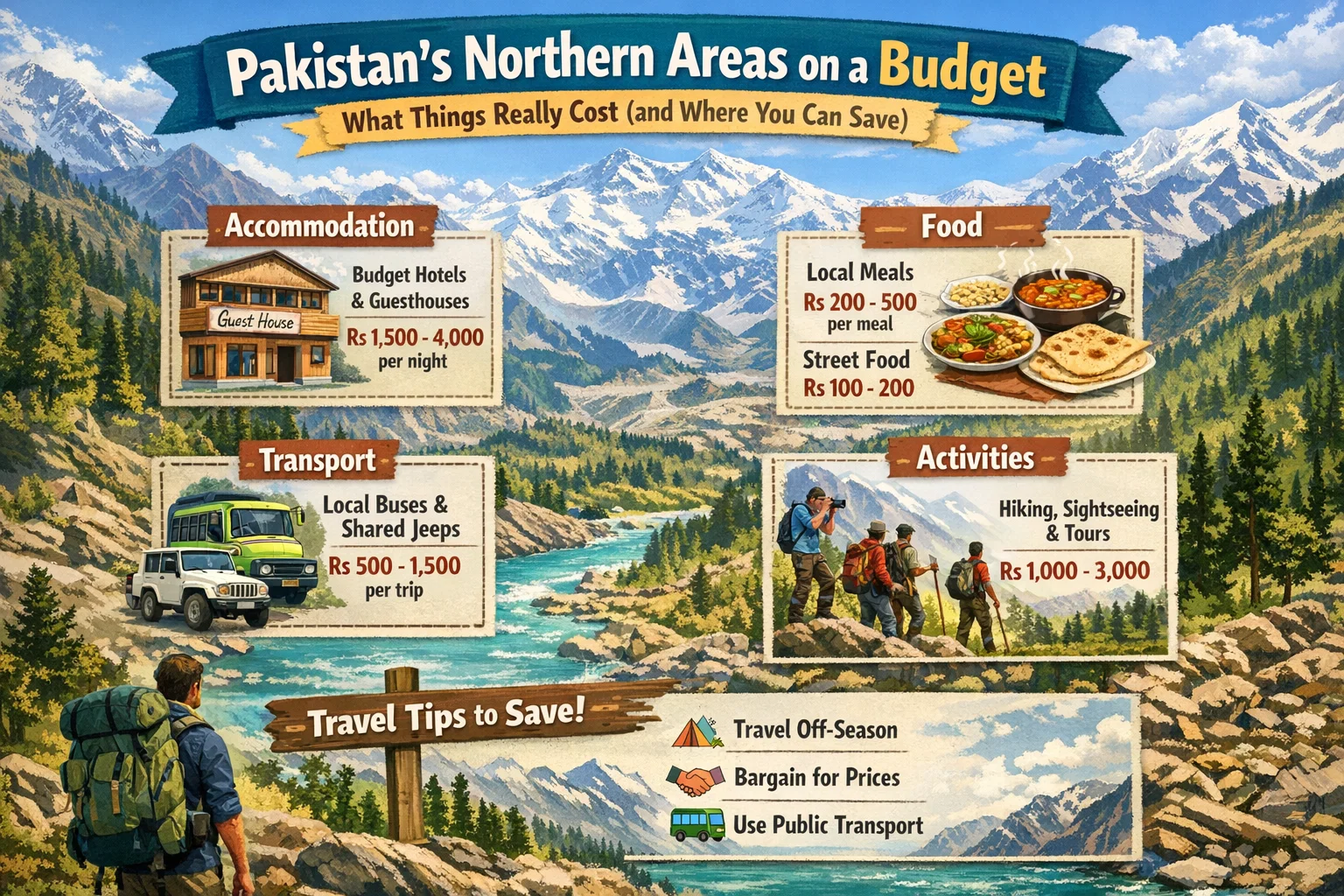
You will spend money in five main places. Transport is usually number one. Accommodation is number two. Food tends to be surprisingly manageable. Guides and jeeps are where day trips can explode your spending. Entry fees are smaller, but they add up if you are the type who stops at every fort and viewpoint.
If you want an easy benchmark, most budget travellers land somewhere between a careful budget and a comfortable budget. A strict shoestring is possible, but it is not always enjoyable once you factor in long drives, altitude, and the fact that sometimes you just want a warm room and a proper meal.
Transport costs, the part that decides everything
Getting from Islamabad to the north
For most people, the cheapest way is public transport. Buses and coaches on the main routes are affordable, but you pay in time and comfort. A good mid range option is a reputable coach service on the Islamabad to Gilgit route. From there, you can move onward to Hunza or Skardu with local transport.
A private car with a driver is a different category. It is the move that turns a budget plan into a “we will see how it goes” plan. It can be worth it if you are sharing with friends and you value stops and flexibility. It is also worth it if you are short on time and you want to break long journeys sensibly.
A useful rule of thumb is this. The moment you switch from buses to private transport for long distances, your daily average jumps sharply, even if everything else stays basic.
Local travel, Hunza and Skardu style
Within the valleys, local transport is cheap but not always convenient. It exists, but it runs on local schedules and patience. If you are comfortable asking around, waiting, and sharing, you can keep costs low.
Taxis and private cars in towns can be reasonable for short trips, but day hires can climb, especially in peak season. A jeep for places like Deosai, some Skardu side valleys, or high viewpoints is where budget discipline gets tested.
The biggest money saver, share the jeep
If you take one thing from this piece, let it be this. Sharing a jeep is the difference between “that day trip was fine” and “that day trip just ate my whole week’s budget.” In Hunza and Skardu, it is common to find other travellers who want the same route. Your guesthouse can often help you group up.
Accommodation, what you really pay for a bed with a view
In the Northern Areas, you can usually find three broad tiers.
The first is very simple guesthouses. The room is basic, the bathroom might be shared, and the value is strong if you are mostly outside all day.
The second is the comfortable sweet spot. Clean room, private bathroom, hot water most of the time, and staff who can organise transport without drama. This is where many budget travellers end up once they do the maths. Paying a bit more can save you money elsewhere, because a helpful place often reduces the number of expensive mistakes you make.
The third is view hotels and boutique stays. Sometimes the view really is special. Sometimes you are paying for the word “view” in the listing while the same panorama is available from the café next door.
Where you can save without suffering is location. In Karimabad, for example, staying slightly away from the most obvious viewpoint properties can cut costs, and you can still walk to the same sunset spots. In Skardu, staying a little outside the tourist cluster can do the same, as long as you are not then paying for constant taxis.
Food, cheaper than people expect if you eat like a person not a content creator
This is one of the nicer surprises. Daily food costs can stay modest if you keep it simple. A typical local meal, chai, paratha, daal, rice, chicken karahi, seasonal veg, these are not expensive in most places.
Where the bill rises is when you chase Western style menus, endless coffees, and dessert stops because you are tired from driving. It is not that you should never do this. It is just that these little add ons quietly become the budget leak.
If you are trying to keep costs down, do a mix. Eat local most of the time. Pick one café stop a day if you love them. Save the “nice dinner” for your best scenery day, so it feels like a reward rather than a habit.
Water is worth a mention. In some places you will be buying bottles constantly. A reusable bottle and a simple filter can reduce cost and plastic, and it also means you are more likely to stay hydrated at altitude.
Guides and tours, when they are worth it and when they are not
You do not need a guide for everything. Many Northern Areas experiences are self guided by default. Forts, villages, local walks, bazaars, these can be done independently if you are comfortable navigating and asking questions.
A guide can be worth paying for when it changes your understanding of the place. A good local guide can turn a walk into a story. They can also help with safety and route choice in areas where trails are not obvious, or where conditions change.
The budget approach is to be selective. Do one guided experience that matters to you. Make it either your big hike day or your culture day. Skip paying for guidance on things you could easily do on your own.
Entry fees and small costs that still add up
Entry fees are usually not the biggest line item, but they are easy to underestimate. Forts and heritage sites may have small tickets. Some viewpoints have parking fees. There are also the quiet extras like paid toilets on highways, snacks at stops, and SIM top ups.
You do not need to avoid all of these. You just need to notice them. People blow budgets in small daily spending when they do not keep track.
Splurge vs save, the choices that feel the most “human”
Here is what tends to feel worth splurging on, even on a budget.
A warm, clean room on a cold night in Hunza or Skardu. The difference in sleep quality is huge, and good sleep changes everything on long road days.
One proper jeep day for a place that would be frustrating otherwise. If Deosai is your dream, do it properly. If you want Khunjerab, do it with a driver who knows the road and timing.
A guide for one meaningful hike. You will remember the stories, not the price.
Here is where saving tends to be painless.
Avoid paying extra for a “view” you can access for free. Northern Pakistan gives scenery generously. You do not need to buy it in every booking.
Use public transport on at least one long hop. It might be slower, but it keeps your average daily cost under control and it often feels more real.
Share transport whenever possible. This is the biggest lever you have.
Eat local most of the time. It is delicious, and it keeps food spending sensible without feeling restrictive.
A realistic daily budget snapshot
A careful budget traveller, using public transport, simple guesthouses, and local meals, can keep daily spending relatively low, with a couple of more expensive days when jeeps or long transfers are involved.
A comfortable budget traveller, mixing public transport with occasional private rides, staying in the mid range sweet spot, and allowing a daily café stop, will spend more but still keep things under control.
The point is not to hit a perfect number. The point is to know what causes the number to jump, so you can choose intentionally.
The bottom line
Pakistan’s Northern Areas are not “cheap” or “expensive” in a single way. They are flexible. You can spend very little if you move slowly and share transport. You can spend a lot without even noticing if you default to private rides and book the most obvious hotels.
If you want to do it on a budget, focus on the big levers. Move smart, not fast. Pay for comfort when it genuinely protects your energy. Save on the stuff that looks good on a booking page but does not change your actual day.
And when the mountains finally appear properly, when the air shifts and the road climbs and the noise of cities drops away, you will be very glad you planned this part well. Because you will be present for it, not stressed about what it cost.
