
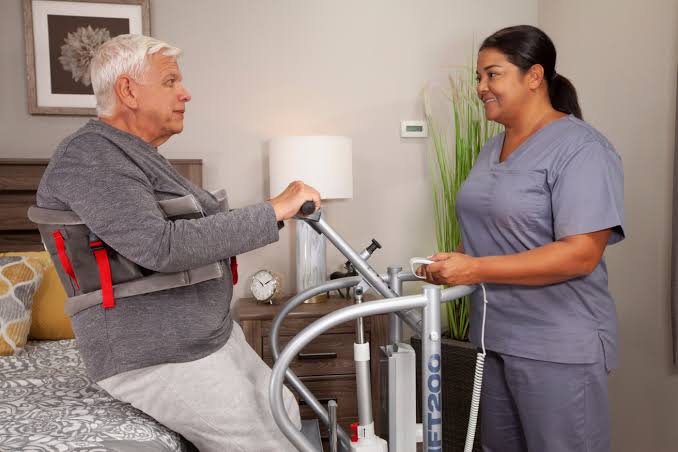
Six transfers a day, roughly 60 kilos of dead weight each time, no hoist and no second pair of hands. That arithmetic is why clinics advertising neck and back pain treatments west palm beach fl and physiotherapy rooms in Leeds end up assessing the same person: an unpaid family carer whose own back started failing months after the caring began. The low back locks after every transfer. Something burns between the shoulder blades. Then one arm begins to tingle, and the problem stops being discomfort and becomes a decision. The case this guide makes is simple: pain that builds out of repeated lifting is a failure of the whole stabilising system, so the assessment worth paying for looks at that system rather than at whichever disc happens to show on a scan.
Daily Transfers Load The Neck And Low Back
A transfer is not a lift. It is a lift plus a twist plus a hold, usually performed in a bathroom with 40 centimetres of clear floor, and it repeats. Load that pattern onto a lumbar spine several times a day and the small stabilising muscles beside the vertebrae fatigue first, which shifts the work onto discs, facet joints and the sacroiliac joint. The neck joins in later, because bracing a parent who is sliding means locking the shoulder girdle and holding the head forward for the length of the move.
In the accounts carers give, what usually turns up is not one dramatic injury with a date attached to it. It is a slow accumulation, noticed on the morning it stops resolving overnight. Tingling down one arm belongs in a different category from muscle ache, because it points at a nerve being compressed somewhere between the neck and the hand rather than at a tired muscle.
The Two Roads After Tingling Starts
The first road is the default, and most carers take it without ever deciding to. Paracetamol or ibuprofen, a heat pack, an appointment cancelled because the parent had a bad night, and a plan to sort it out once things calm down. Things do not calm down. The road is understandable and it is not free: the muscles that failed keep failing, movement patterns adapt around the pain, and the tingling gets treated as an annoyance rather than as a finding.
The medication end of that road has narrowed as well. CDC figures updated in March 2026 put national dispensing at 37.5 opioid prescriptions per 100 people, down from 46.8 in 2019, a fall of roughly a fifth over four years. Those numbers describe the United States, but the direction of travel will be familiar to anyone who has asked a GP for something stronger and been offered a referral instead. A carer arriving with nerve pain is less likely to leave with a prescription and more likely to leave with an assessment to book.
The second road starts with a question rather than a treatment: which parts of the stabilising system have stopped doing their share? Read past the marketing behind a search like neck and back pain treatments west palm beach fl and the more serious practices describe exactly that, treating the complete biomechanical system responsible for spinal stability, movement and pain instead of one isolated structure. In practice that means examining the deep spinal muscles, the facet joints, the sacroiliac joint and the nerve pathway together, then asking which finding actually explains the symptom in front of them. A bulging disc on an image is not automatically the culprit, since plenty of people carry one and lift nothing heavier than a kettle. Non-surgical options sit on this road too, from image-guided injections to orthobiologic and laser-based treatments, and their appeal to a carer tends to be practical rather than philosophical, because nobody caring alone for a parent can disappear for a six-week surgical recovery.
A rule of thumb helps at this fork. If the tingling tracks with position and settles within a day, the assessment can be a booked appointment in the ordinary way. If it persists beyond two weeks, or the arm has measurably lost grip strength, that assessment moves to the front of the queue and stops being something to fit around the caring rota.
Questions To Ask Before Choosing Either Road
Both roads end up with someone in a consulting room, so the questions asked there matter more than the label on the door. A carer has limited hours and almost no flexibility, and the honest test of a clinic is whether it will say plainly what it intends to examine and what it cannot fix. Ask before booking, not afterwards.
- What will you assess besides the disc? A good answer names the deep spinal muscles, the facet joints and the sacroiliac joint, not just an MRI report.
- If the scan and my symptoms disagree, which one do you treat? The answer you want is the symptoms, with the image used as a cross-check.
- How many appointments will this take, and how much can be done in one visit? A clinic used to carers gives a number instead of an open-ended course.
- What happens if the tingling is coming from my neck rather than my wrist? Naming who they refer to, and when, is a better sign than confidence that they handle everything.
Some symptoms end the deliberation entirely. New weakness in an arm or leg, numbness spreading across the saddle area, or any loss of bladder or bowel control alongside back or neck pain is a medical emergency: go to A&E or call 999 immediately, and do not wait for an appointment. Waiting carries a cost in the milder cases as well, and the NIH’s MedlinePlus entry on carpal tunnel syndrome states that rule bluntly: left untreated, the compression can permanently damage the median nerve and leave lasting weakness, numbness and tingling. The same logic holds wherever a nerve is being squeezed, which is why a tingling arm earns a diagnosis rather than a wait.
A Body That Lifts Needs A Plan
A carer’s plan usually has one line in it, and that line is keeping the parent safe. Adding a second line is not selfishness, it is arithmetic, because the transfers stop altogether if the person doing them cannot straighten up. That second line stays short: name the symptom out loud, get the whole stabilising system assessed rather than one disc, and know which signs mean today instead of next month. The spine keeps its own ledger, and it settles up later, usually at the least convenient hour. Better to read it early, while the choices still include the ones that do not involve a theatre and six weeks away from the person who needs lifting.
