
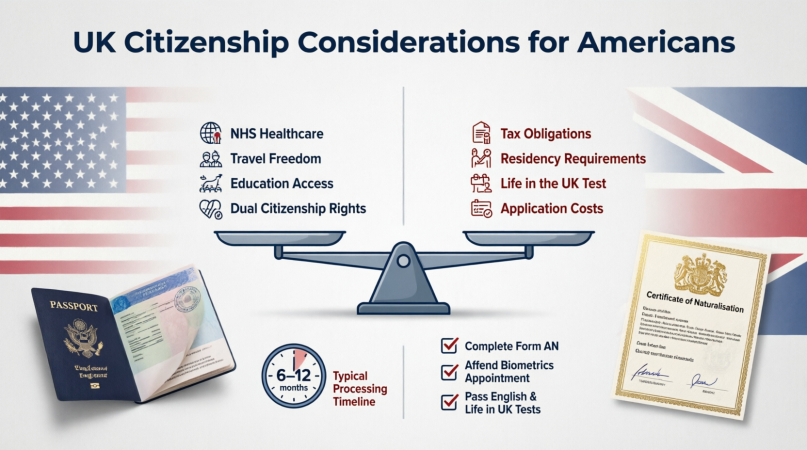
For a lot of Americans, the idea doesn’t come up right away. It tends to build over time.
You move to the UK for work. A few years pass. Maybe you’ve settled into a routine in London or Manchester, your social circle is there, and your career has shifted locally. At some point, the temporary setup starts to feel… less temporary.
That’s usually when citizenship enters the conversation. Not as a big statement, but as a practical next step.
Still, what it actually changes isn’t always as straightforward as people expect.
Does Becoming a UK Citizen Change Your Taxes?
Not really, at least not from the US side. The Internal Revenue Service taxes based on citizenship. So even if you become a UK citizen, you’re still required to file a US tax return each year and report your worldwide income.
It catches people off guard. There’s often an assumption that becoming British somehow “replaces” your US obligations. It doesn’t.
You’re simply adding another layer, not swapping one system for another.
How UK Citizenship Affects Your UK Tax Position
On the UK side, citizenship doesn’t carry the same weight for tax purposes.
The UK focuses on residency, not nationality. The rules set by HM Revenue & Customs look at where you live, how long you stay, and how connected your life is to the country.
So if you’re already a UK tax resident, becoming a citizen doesn’t suddenly change how you’re taxed. And if you’re not a resident, citizenship alone doesn’t automatically make you one.
It’s a bit counterintuitive, but status and tax don’t always move together.
Dual Citizenship: What It Really Means for Taxes
Holding both passports is a meaningful milestone — but from a tax standpoint, it doesn’t change much. US-UK dual citizens still file annually with the US, and UK tax obligations continue to be driven by residency. The US-UK Tax Treaty helps reduce double taxation, but it doesn’t eliminate the core filing requirements. In practice, dual citizenship tends to reshape long-term options more than it does everyday tax life.
Financial Considerations Before Becoming a UK Citizen
This is where things get a bit more practical.
Take ISAs, for example. In the UK, they’re designed to be tax-efficient. Gains and income inside the account are generally tax-free. From a US perspective, though, that benefit doesn’t carry over. The income can still be taxable, depending on what’s inside.
Or consider UK-based investment funds. Many fall under PFIC rules in the US, which can lead to complicated reporting and, in some cases, higher tax exposure than expected.
Even pensions can sit in a grey area, depending on how they’re structured and reported across both systems.
None of this means you should avoid these options entirely. But it does mean the decision isn’t just about UK rules. It’s about how both systems interact.
Legal and Practical Implications
Outside of tax, citizenship does offer clear advantages.
You gain the right to live and work in the UK without relying on visas. That alone can remove a lot of uncertainty. Travel can become easier as well, especially within certain regions.
But it doesn’t replace your US citizenship unless you take additional steps, and that’s a separate decision entirely. For most people, dual citizenship becomes the default outcome.
Which is fine. Just not quite as simplifying as it sounds at first.
Timing Matters More Than You Think
One thing that often gets overlooked is timing.
Becoming a UK citizen doesn’t exist in isolation. It sits alongside other decisions. When you move, when you earn income, when you sell assets. All of these can interact in ways that aren’t obvious at first glance.
For instance, someone might become a citizen shortly after restructuring their investments, without realizing how those changes are treated across both tax systems.
A bit of planning beforehand can make those transitions smoother. Without it, you’re often reacting after the fact.
Common Misconceptions About UK Citizenship
A few assumptions come up repeatedly:
- “It will simplify my taxes”
In reality, your US obligations remain unchanged - “I won’t need to deal with the IRS anymore”
You still file annually, regardless of where you live - “Dual citizenship gives me tax advantages”
In most cases, it doesn’t change the core rules
These ideas make sense on the surface. They just don’t hold up once both systems are involved.
How to Decide If UK Citizenship Is Right for You
At some level, this isn’t just a tax question.
It’s about where you see your life long-term. Whether you plan to stay in the UK indefinitely, how stable you want your residency status to be, and how comfortable you are managing obligations in two systems.
For some, the benefits clearly outweigh the downsides. For others, the added complexity might give pause.
There isn’t a single right answer. Just a better-informed one.
Need Help Planning Your US Taxes Before or After Citizenship?
If you’re weighing up UK citizenship, the tax side doesn’t need to be the deciding factor. But it probably shouldn’t be an afterthought either.
The overlap between UK and US rules can be subtle at times, and small decisions can carry forward in ways that aren’t immediately obvious.
Expat Tax Online works with Americans in the UK navigating exactly these kinds of transitions. Whether you’re planning ahead or trying to make sense of your current setup, having a clearer view of both systems can make the decision feel a lot more grounded.
